
FY2027 Business Insights: What We’re Seeing and What Matters Next
Business Trends
Private businesses are entering the 2027 financial year with tighter margins, more cautious customers, and heavier compliance and cashflow burdens.
Our long-held view that we are experiencing a bottom-up recession is now being recognised as a cost-of-living crisis for individuals and families. It is also affecting a wide range of smaller businesses that cannot pass on the full extent of their cost increases. Higher prices are suppressing sales growth, while businesses’ absorption of a proportion of these increases is reducing margins, with corresponding cashflow implications.
This is now being compounded by Payday Super, which came into effect on 1 July 2026. All payroll runs, whether weekly, fortnightly or monthly, now require Super Guarantee payments to be received by the fund within seven days of the payroll cycle.
The Economy & Outlook
As we know, the Reserve Bank of Australia held the cash rate at 4.35% in June 2026 after earlier increases this year, noting that inflation remains too high and economic activity is slowing. This slowdown is evident across the firm’s diverse client base.
The outlook has been further complicated by the recent Federal Budget and changes to negative gearing, capital gains tax (CGT), and the taxation of trusts.
The consensus within our network, however, is that government spending is propping up the broader economy and preventing an economy-wide recession, while small businesses are effectively experiencing a recession now.
This is supported by the current experience of clients that rely on, or supply into, channels dependent on discretionary consumer expenditure. It is also reflected in the depressed share prices of nearly all consumer-driven ASX-listed entities, other than Coles and Woolworths.
Our client networks are experiencing unusually wide fluctuations in hospitality bookings, which is unsettling. Forward bookings for overseas and domestic travel have also fallen considerably over the past month, even among the more affluent baby boomer demographic.

Michael - stock.adobe.com
Business Opportunities
While the economic outlook remains uncertain and more negative than positive, there are genuine opportunities across a number of industries.
Uncertain times make existing business relationships far more valuable. Getting out and talking to your customers, who are probably experiencing many of the same issues and concerns, is one way to counteract the negatives. It can build loyalty and uncover previously unidentified areas of growth and opportunity.
This is the most significant driver of improved sales among the firm’s diverse range of clients that have made the time to communicate systematically with existing customers, suppliers, and referrers.
With the changes to capital gains tax, many businesses will be seeking valuations at the end of FY2027. They will also be seeking additional complex structural advice as the foreshadowed changes to trusts emerge and legislation is drafted.
While valuations and structural advice are the domain of accountants and valuers, businesses should use these changes as an opportunity to assess their valuation readiness and their ability to provide evidence-based strategies for growth, rather than relying solely on past financial performance. Optimal valuations rely on confidence in a business’s ability to maintain and grow profitability.
Understanding your “valuation readiness” is an important first step. With valuers and accountants expected to be run off their feet, being well prepared and presenting compelling market information and forecasts will have a significant impact on the enterprise value of most businesses.
The Southern Riverina
While the firm has worked across a range of agricultural businesses for many years, extensive work has been undertaken in the Southern Riverina since late last year. This work has assisted a number of landholders to reposition themselves so they can influence policy decision-making.
It has given us deep insight into the dynamics of a largely irrigated agricultural region and the challenges faced by its communities as the Murray–Darling Basin Authority (MDBA) continues to buy back productive water entitlements for environmental use.
The loss of productive water and the increasing cost of water, compounded by a dry period of low allocations and high diesel and fertiliser costs, have given us an intimate understanding of the challenges currently being faced by regional communities.
To represent these communities more effectively and cut through ideologically driven views about the health of the Murray, the firm developed a place brand for the region with a narrative that better represents the region’s economic, social, First Nations, and environmental contribution to the nation.
The “Murray Heartlands” place brand was the name under which a vitally important MDBA submission was prepared for the firm’s clients.
For those interested, the Murray Heartlands website and the resulting MDBA submission can be found at:
The development of Murray Heartlands and the submission to the MDBA represent some of the finest work undertaken by the firm.
They are the result of extensive stakeholder engagement, firm-wide collaboration, connectivity, and ongoing rolling research. This process has identified, tested, and applied messaging that neutralises urban environmental ideology while reinforcing the role of all stakeholders in the region.
This work has reinforced the importance of evidence-based advocacy, stakeholder engagement, and a clear environmental narrative when regional communities are seeking to influence policy outcomes.

Advisory Services & Trends
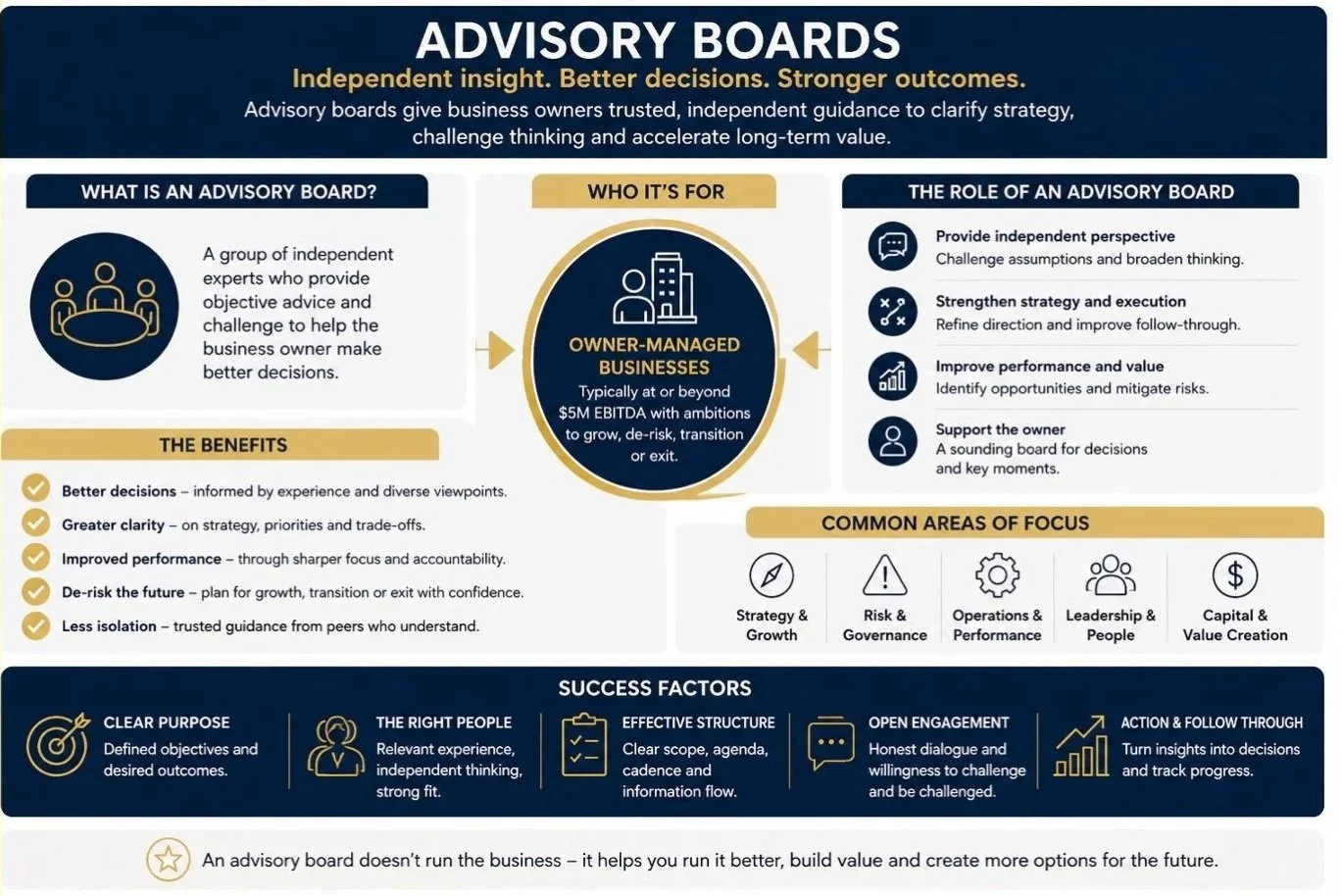
The firm has a long history of working with businesses over prolonged periods and becoming a trusted source of advice and assistance. These engagements have often evolved into retained relationships and the formation of advisory boards, which the firm widely encourages because they provide the scaffolding to support sustained growth and profitability.
When formed as part of a planned program of growth and development, advisory boards can formalise a business’s plans developed with existing service providers. They can also bring discipline and accountability to the organisation without any loss of control.
Advisory boards provide regular reporting against planned programs and strengthen the value delivered by existing service providers, whether they are the company’s external accountants or business advisers such as nem.
Please do not hesitate to reach out to a nem Partner if you feel your business could benefit from establishing an advisory board.
Advisory boards can take many shapes and forms and can be a highly cost-effective way of leveraging broader experience, particularly as external members learn more about your business.
nem Australasia Pty Ltd